Picture this: it’s the third business day of the month and your servicing lead is halfway through investor reconciliation—the part that requires holding four numbers in her head at the same time—when the phone rings. A borrower wants to know if his draw request has been approved.
Now, the call itself takes ninety seconds; your servicing lead has the answer on her screen. The borrower thanks her and hangs up. Then, she goes back to reconciliation—except not right away.
She clears the two emails that landed while she was talking, reopens the tabs she closed, and spends a few minutes finding her place in the file again. By the time she’s genuinely back in it, the interruption has cost a good deal more than ninety seconds. That call will happen another forty times this month.
When the volume gets bad enough, your instinct may be to put another person on the phones. But that’s an expensive answer to a question many lenders have yet to diagnose. So, before you start spending on increasing your headcount, let’s look more closely at the challenge.
The Calls Private Lenders Actually Get
Most writing that you’ll find about reducing borrower calls is aimed at retail loan officers at bank shops, where the questions are about rate locks and closing dates. In these scenarios, there’s a call center to absorb the deluge, but private lending servicing looks nothing like that.
The questions your team has to field are narrower, more repetitive, and almost entirely about information you already have:
- Was my draw approved, and when does it land?
- Can I get a payoff quote good through Friday?
- How much interest accrued this month?
- My loan matures in 60 days. What happens now?
- Did you receive my wire?
None of these are complaints; they’re reasonable questions from borrowers who have no way to see all that you can see. And there are more of them every year: private lending origination units rose 13% year-over-year in the first quarter of 2025, with total volume surpassing $33.2 billion and more than 7,565 lenders originating loans in the quarter. That’s a more than 20% increase over the prior year!
What it points to? Portfolios are growing. Servicing teams usually aren’t.
Where the Cost of Status Calls Actually Shows Up
Here’s the part that makes status calls easy to underestimate: the work still gets done.
Nearly two decades ago, researchers at UC Irvine and Humboldt University ran a controlled study on exactly this, published as The Cost of Interrupted Work: More Speed and Stress. Via this oft-cited study, they found something counterintuitive. People who were interrupted throughout a task actually finished said task faster than people who weren’t, with no measurable drop in quality. They compensated by working more quickly and writing less.
The cost did show up, however. It just showed up somewhere else. After only twenty minutes of interrupted work, participants reported significantly higher stress, frustration, time pressure, mental workload, and effort than participants who worked undisturbed. That study’s conclusion (though now old enough to vote) is worth sitting with: interrupted work may get done faster, but at a price.
That’s why this never appears on a P&L. Nothing is late; nobody drops a file. The team simply absorbs it, works faster and tighter to stay on schedule, and burns out eighteen months earlier than anyone expected.
The volume is worth estimating rather than guessing at. Take your active loan count, estimate how many borrowers call with a status question in a typical month, and multiply by the call length plus the time it realistically takes someone to get back into what they were doing. For a 300-loan portfolio where a third of borrowers call once a month, even a conservative fifteen minutes of total disruption per call comes to roughly 25 hours—most of a work week, every month, spent relaying information the borrower might have looked up.
Again, this isn’t unique to private lending, but it lands differently here. In a large shop, answering the phone is somebody’s actual job. In a five-person operation, the interruption lands on the same two people handling reconciliation, draw review, and investor reporting. The Mortgage Bankers Association’s Servicing Operations Study and Forum counts call centers among the base direct costs of servicing every performing loan, regardless of default status. Far from an exception, it’s overhead.
Why “We’ll Add a Portal” Doesn’t Automatically Fix the Problem
The obvious answer to this conundrum would appear to be self-service. But this is where a great many lenders spend money and see the call volume barely move.
In 2024, Gartner surveyed 5,728 customers and found that while 73% use self-service at some point, only 14% of issues are fully resolved there. Even for issues customers described as very simple, the figure was 36%. The two most common failure modes here are instructive: in 43% of cases the customer couldn’t find content relevant to their issue, and 45% felt the company didn’t understand what they were trying to do.
A portal that doesn’t answer those five questions we mentioned earlier doesn’t reduce calls. It just adds a step before the call.
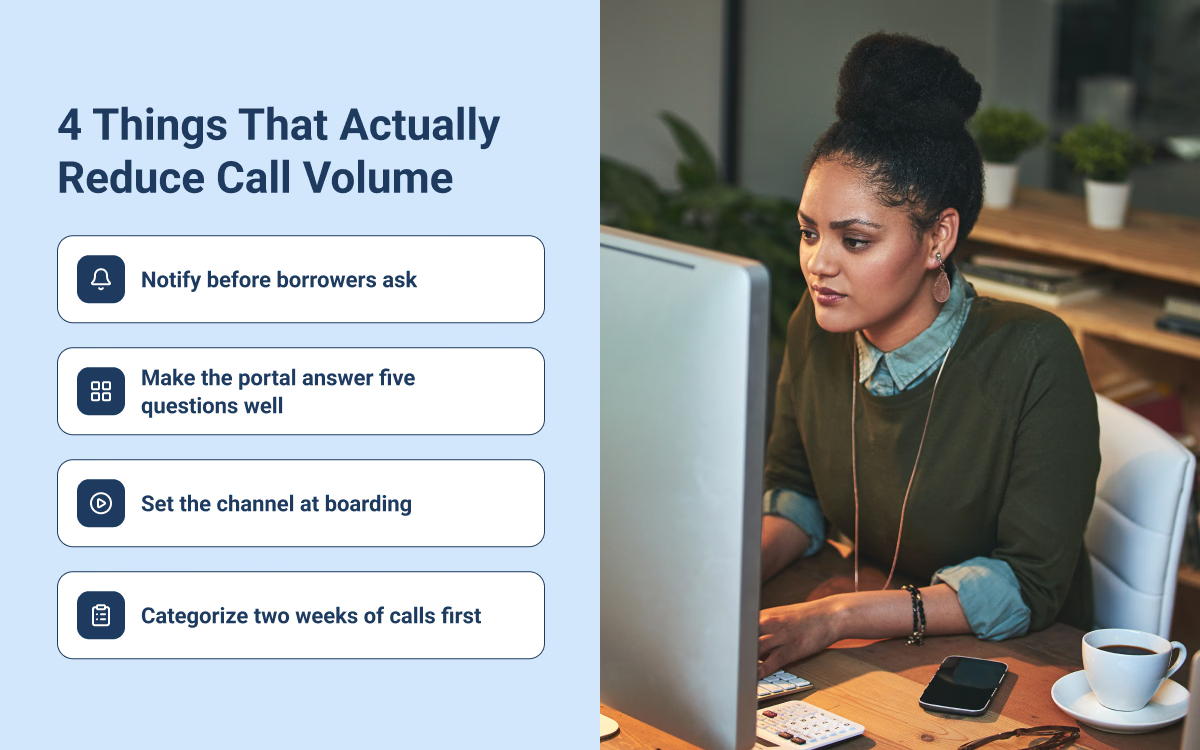
Four Things That Actually Reduce Call Volume
- Send the update before the borrower asks for it. Draw status changes, payments posting, maturity approaching, wire received. Every proactive notification is a call that never happens. J.D. Power’s 2026 U.S. Mortgage Servicer Satisfaction Study ranks “keeps me informed and educated” among the core dimensions of the servicing relationship, and found that borrowers who receive clear explanations of basic servicing fees are 35 percentage points more likely to rate their trust as excellent.
- Make the portal answer five questions well rather than fifty poorly. Payoff figure, draw status, payment history, accrued interest, maturity date—that’s the list. Depth on the questions borrowers actually ask beats breadth on the ones they don’t.
- Set the channel at boarding. A five-minute walkthrough at closing determines the default behavior for the life of the loan. Borrowers who log in once during onboarding call meaningfully less than borrowers who receive credentials in an email they never open.
- Categorize two weeks of calls before you change anything. Keep a tally sheet. Log every inbound borrower call by type for ten business days. Most lenders discover that three question types account for the large majority of volume, which turns a vague problem into a specific, solvable one. This costs nothing and it’s the step most teams skip.
The same J.D. Power study found that strong self-service capability is now one of the top three drivers of borrower loyalty, at 62%, and that difficulty with self-service is a leading reason borrowers consider leaving. The upside and the downside sit on the same feature. It’s not if you implement it; it’s how.
The Bottom Line on Borrower Status Calls
The goal isn’t fewer conversations with your borrowers. The goal is more productive communication and fewer interruptions—the calls that transfer no information the borrower couldn’t have retrieved on their own, at a moment when your team is doing work that requires their full attention.
Getting there is mostly operational discipline: know which questions are driving your volume, answer those questions proactively, and give borrowers a reliable place to look. Done well, none of it requires another hire in headcount. It just requires that fewer calls need answering in the first place.
Mortgage Automator's borrower and broker portals and automated status notifications are built into the loan servicing workflow rather than bolted onto it.
If your servicing team is still fielding payoff and draw status calls that eat into their day, book a demo and we'll show you how borrowers and brokers can get those answers themselves.
Frequently Asked Questions (FAQ)
What causes borrowers status update calls in private lending?
Most status calls come from a small set of recurring questions: draw approval and funding timing, payoff figures, accrued interest, maturity and extension terms, and payment confirmation. They typically reflect a visibility gap rather than a service failure: the borrower is asking for information the lender already has but hasn’t shared.
Does a borrower portal actually reduce call volume?
Yes and no. A borrower portal reduces call volume only if it resolves the questions borrowers are actually asking. Industry research consistently shows that most self-service attempts fail because customers can’t find content relevant to their specific issue. A portal that covers a lender’s highest-volume question types reduces calls; a general-purpose portal often just forestalls them.
What is proactive borrower communication in loan servicing?
Proactive communication means sending loan updates when a status changes rather than waiting for a borrower to ask. Common triggers include draw approvals, payment posting, upcoming due dates, escrow or fee changes, and approaching maturity.
How do I measure how many status calls my team is getting?
Log inbound borrower calls by question type for ten business days. Most servicing teams find that a handful of categories account for the majority of volume, which makes it clear where self-service or automated notifications will have the greatest effect.
Can I reduce servicing call volume without hiring?
Absolutely. Because most status calls stem from information access rather than complexity, they respond well to proactive notifications and targeted self-service. Reducing interruption volume also protects the focus of the staff already handling reconciliation, draw review, and investor reporting. If you address the challenge of borrower status call volume strategically, there is no need to increase your headcount.