
Before You Fund Webinar Recap
Private lenders are operating in one of the highest-fraud environments we have seen, and most due diligence processes have not kept pace. On June 25, I hosted a panel of four industry specialists to talk candidly about the gaps, what fraud looks like today, and what it actually takes to protect your portfolio before you fund.
Our panelists:
- Denise James: SVP at Xactus, credit reporting, fraud prevention, and identity verification
- Victor Tay: CEO and Co-Founder at Minerva, anti-money laundering (AML) and financial crimes screening; former Chief AML Officer at Wells Fargo Canada
- Meghan Askin: SVP of Sales at AFX Research, public record title reports
- Kris Anderson: Partner, Trinity River Financial Insurance, lender-placed and real estate owned (REO) coverage
Here is what stood out.
Key Takeaways
- Fix-and-flip and construction carry the most hidden risk: Both loan types involve ongoing capital deployment. Construction loans have draw schedules that create repeated windows for new liens and title issues. Fix-and-flip properties sit vacant longer than expected, and vacancy creates its own exposure. A one-time upfront check is not enough for either.
- Screen the people behind the entity, not just the entity itself: Digital synthetic identity fraud jumped 311% between 2024 and today. A clean limited liability company (LLC) with no adverse media history is easy to manufacture. Beneficial ownership, connected entities, and fund flow must all be part of the picture.
- AI has changed what fraud looks like: A convincing fake borrower package, including bank statements, tax returns, corporate docs, and business history, can now be built in minutes. AI-generated forgeries made up over 57% of all detected fakes in 2024. If a package looks too good, that is a signal, not a green light.
- Speed and due diligence are not mutually exclusive, but only if compliance is built into the process early: Bad actors count on compliance being an afterthought. Getting verification automated and integrated into the workflow from the start removes the pressure point.
- Title searches belong at origination, not just at closing: An early owner title search catches ownership discrepancies, undisclosed liens, and deed fraud before capital is committed. For construction loans, a title update before every draw is the only way to confirm a clean title as the project progresses.
- Domestic background checks alone are not enough: Victor walked through a real case in which a client appeared clean domestically but had significant fraud exposure across Europe and Asia. Any borrower with signals pointing outside your jurisdiction warrants a broader AML and adverse media search.
- Insurance gaps show up after it is too late unless you plan: Set up a master lender-placed insurance policy before you need it, not after a borrower disappears, and the property is already sitting uninsured.
- Know your high-risk markets: Application fraud is up 6.1% year over year. Hotspots include New York, Rhode Island, Connecticut, California, and Florida. Non-owner-occupied properties trigger fraud alerts at 2.5 times the rate of owner-occupied. One in 29 multifamily applications is flagged.
What the Panelists Would Change
- Denise James: Make due diligence product-specific. Every loan type fails differently.
- Victor Tay: Stop treating it like a checklist. The goal is understanding who you are actually doing business with. Trust, but verify.
- Meghan Askin: Make public record-verified title updates standard at early collateral screening, not just at closing.
- Kris Anderson: Use the National Private Lenders Association (NPLA) Fraud Watch List. And get your master insurance policy in place before you need it.
Resources
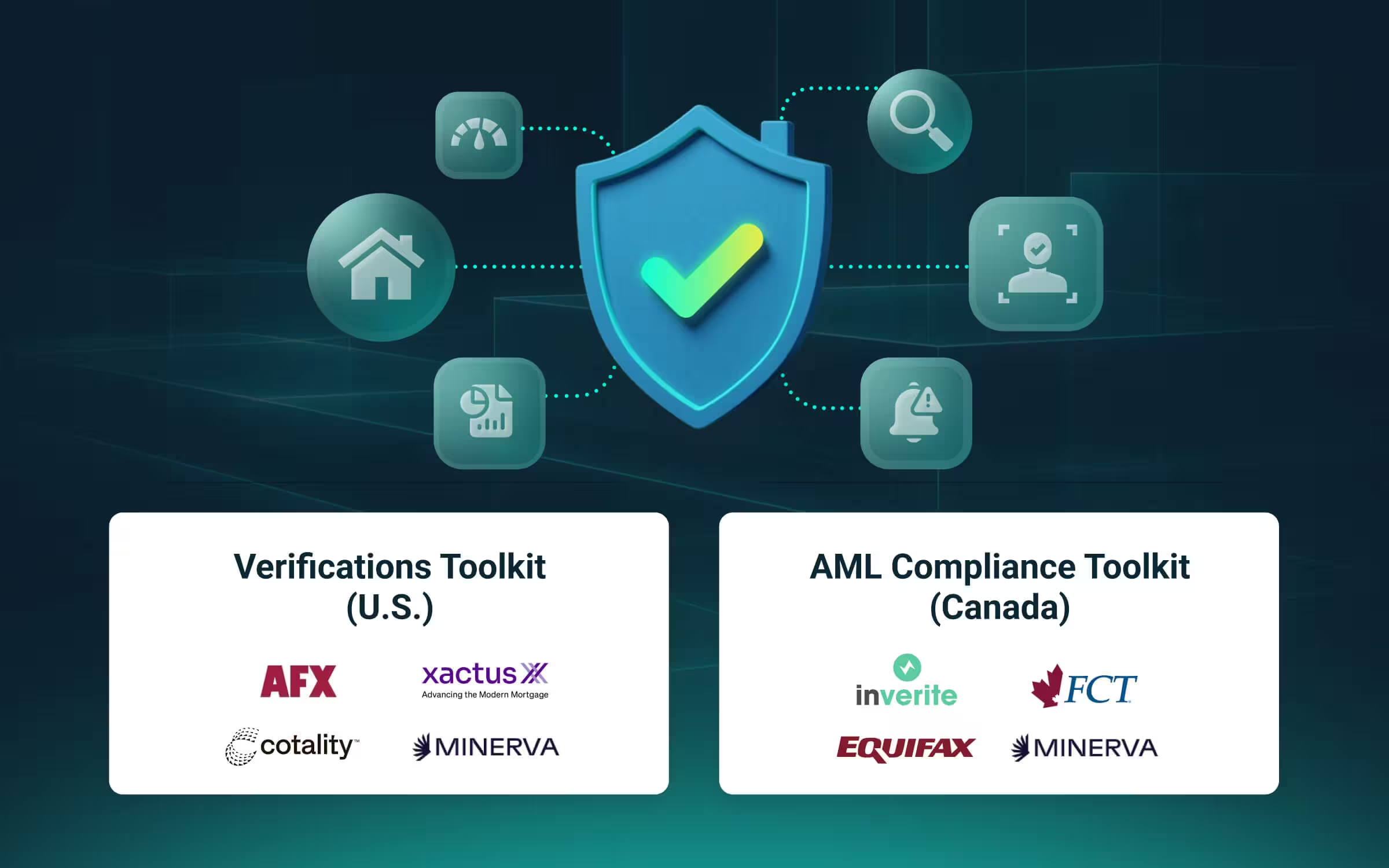
Mortgage Automator customers have access to built-in verification and compliance toolkits designed to bring these due diligence checks directly into your lending workflow. Existing customers: contact your Customer Success rep for access. Not yet a customer? See how it works.
Want to know what else is in our ecosystem? See all our partners and integrations.
The full transcript follows. Watch the on-demand webinar.
Webinar transcript
Introductions
Alex Smith (Mortgage Automator):
Welcome, everyone. I'm Alex Smith, Head of Marketing at Mortgage Automator, and I'll be your host today. Thank you for joining us for Before You Fund: The Due Diligence Blueprint for Private Lenders.
We're doing this one without slides. The whole idea is to have a real conversation with some of the best people in the business on this topic.
Mortgage Automator provides loan origination and servicing software for private lenders across the U.S. and Canada. Our platform is purpose-built for the workflows private lenders actually use, and part of that is our integration ecosystem, which includes partnerships with the companies our panelists represent today.
Denise James (Xactus):
Thank you, Alex. My name is Denise James. My role at Xactus is Senior Vice President of our Origination and Servicing Quality Control, Fraud, and Tenant Screening Divisions. Xactus integrates with Mortgage Automator for credit reporting, fraud prevention, and identity verification solutions.
Victor Tay (Minerva):
Hi everyone, my name is Victor Tay. I'm the CEO and co-founder at Minerva. We're an anti-money laundering financial crimes platform that integrates with Mortgage Automator for anti-money laundering screening. Before founding Minerva, I was the Chief Anti-Money Laundering Officer at Wells Fargo Canada and also served as the head of data analytics and AML strategy at CIBC. I've been in the industry for 20-plus years.
Meghan Askin (AFX Research):
Hi everybody, my name is Meghan Askin. I'm SVP of Sales at AFX Research. AFX is a nationwide property research firm specializing in public-record-verified title reports. Since 1995, we've researched more than $2.5 trillion in assessed property value across multiple industries, including the private lending space. Through our integration with Mortgage Automator, lenders can access fast, flat-rate title updates, otherwise known as current owner searches, directly within the platform. These reports give lenders a verified snapshot of title at the moments that matter most: early collateral screening, construction and renovation draws, and any point where capital is on the line.
Kris Anderson (Trinity River Financial Insurance):
Hi everybody, I'm Kris Anderson with Trinity River Financial Insurance. We're an insurance agency based in Dallas, Texas, that specializes in private lending and real estate investment. We provide lender-placed insurance and REO coverage to lenders in all 50 states, as well as borrower coverage for fix-and-flip, rental, single-family, multifamily, commercial, and flood insurance.
Which Loan Products Are Carrying the Most Hidden Risk?
Alex Smith:
Before we jump into our first question, we ran a quick poll asking: which loan product carries the most hidden risk, fix-and-flip, bridge, construction, or debt service coverage ratio (DSCR)? Construction and fix-and-flip tied at 40% each. Are these loan types exposed to different kinds of fraud, or are they more or less the same problems wearing different clothes?
Denise James:
It's wearing different clothes, but it's definitely a different landscape. Each construction project or loan being looked at has underwriting built around the ability to repay and income, really mitigating any potential obligations against the property.
Meghan Askin:
From a title perspective, construction loans and renovation projects involve multiple funding events, creating more opportunities for liens, judgments, or other title issues to arise after origination. Ongoing title visibility is important because lenders continue deploying capital throughout the project. That's why they carry the most hidden risk as well.
Kris Anderson:
I agree. With fix-and-flipping, the time it takes to sell or rent those houses has increased, and the longer a property sits vacant, the more trouble can occur. On the construction side, there's also a hidden risk in draw requests; fraud can occasionally be hidden behind them.
LLC and Entity Fraud: Who's Really Behind the Deal?
Alex Smith:
Many borrowers in private lending enter as LLCs or corporate entities. How does that change your due diligence approach, and have you seen fraudsters use corporate structure to their advantage?
Denise James:
What we're seeing, regardless of loan type, is that digital synthetic identity fraud remains enormous. There was a 311% jump in that particular type of fraud, which uses anonymity to create entities, just between 2024 and today. AI has built borrower profiles that pass verification, only to bust out. When you look specifically at DSCR loans, 1 in 27 multifamily applications is flagged, often due to a business-entity takeover. So doing a deep dive into the business entity is critical: who owns it, who the beneficial owner is, who can sign on the loan, what connected entities exist, and whether funds are being transferred between entities you haven't been introduced to.
Victor Tay:
LLCs and other corporate entities are very common and typically not the problem. It's always the people behind the company who pose the risk. A company can look super clean while the real risk sits behind it. From an AML perspective, the key questions are: who owns it, who controls it, and who's benefiting from the loans? A new LLC has very little history, no adverse media, no sanction exposure, but it's the people behind it who will carry fraud issues, lawsuits, sanctions, and other red flags. Fraudsters use companies to create distance, and a sense of legitimacy, and good due diligence closes that gap.
Kris Anderson:
We see people continually creating and recreating different LLCs to try to cover up their claims history. It becomes an issue on the insurance side, too; they're essentially running away from a loss ratio.
Has Institutional Capital Changed Due Diligence Expectations?
Alex Smith:
We've seen private credit grow dramatically over the past few years, and now institutional capital is entering the space with its own compliance expectations. Has that changed what private lenders are expected to do in terms of due diligence, and is the industry keeping up?
Victor Tay:
Yes, the expectations have definitely changed. Private credit has grown very quickly, with more capital, more brokers, more partners, and more pressure to move fast throughout the ecosystem. But more volume doesn't always mean better controls. Bad actors are constantly looking for weak links in the chain. If one lender has a strong AML or fraud program and another doesn't, it's obvious where the bad actor will go.
Is the industry keeping up? It's definitely improving, but not uniformly. Firms that are keeping up are treating due diligence as a real risk management activity and a competitive advantage, rather than a checkbox exercise.
Denise James:
While some lenders practice comprehensive due diligence, others may still believe that collateral alone will mitigate losses. That's a false sense of security. By the time the first incident is uncovered, you may have already opened the door to further attacks, and before you know it, you have a ring and millions of dollars in losses. Fraud is profitable to the threat actor but devastating to the victim, and the victim is your organization.
Where Does the Pressure to Close Fast Create Gaps?
Meghan Askin:
The greatest pressure I see affecting lenders is the need to move quickly. With speed, lenders win deals, close faster, and execute more loans. But speed without due diligence is just faster risk, and it often creates big delays and expensive problems down the line.
When private lenders feel pressure to move quickly, a gap emerges: a tendency to bypass early collateral screening. A borrower could present themselves as the owner of a property when the public record tells a different story. Undisclosed liens, debt, or recent ownership changes that don't match the public record are exactly the kinds of discrepancies that can go undetected when the process moves too fast.
A similar gap emerges during construction loans. Mechanics' liens filed by unpaid contractors or subcontractors are often recorded between draws, jeopardizing the lender's lien priority. Either way, the title should be checked. With an average turnaround time of 0.43 business days for our title update reports, lenders don't have to sacrifice speed for title visibility.
Victor Tay:
Speed itself isn't the problem; it's when speed is used as an excuse to cut corners. The friction I've seen throughout my career happens when compliance is looped in way too late or when the process is too manual. Bad actors know how to use that tension to their advantage. The solution isn't to slow everything down. It's to involve compliance earlier, automate repeatable work, and use technology as an aid.
AI-Powered Fraud: What Does a Convincing Fake Package Look Like?
Alex Smith:
How is AI being used to fabricate borrower profiles, manufacture documents, and pass surface-level screenings?
Victor Tay:
It's super easy now to make convincing packages. AI is changing the unit economics of fraud. In the past, building a fake package took a lot of time. Now you've got an entire borrower story assembled in seconds. The package looks clean, the documentation is abundant, and the story sounds believable, but it could all be fake.
Lenders now need to assess not only whether something looks real, but also prove that it is. Are the parties legitimate? Do the addresses match? Do the bank records make sense? Are there lawsuits, adverse media, or hidden relationships? AI can just as equally be used to vet and validate documents and detect synthetic IDs and altered bank statements.
Denise James:
There's been a shift in fraud; it's no longer document alteration. It's end-to-end identity simulation, with internally consistent borrower ecosystems built in minutes. If it looks too good, there's probably something there.
AI-enabled fraud losses are projected to grow from $12.3 billion in 2023 to over $40 billion in 2027. AI-generated document forgeries climbed from 0% in 2021 to over 57% of all detected fakes in 2024.
Three converging tactics to be aware of: fabricated synthetic identities for both borrowers and business entities; manufactured document stacks, including tax returns, articles of incorporation, and business licenses; and deepfake-enabled verifications, where a borrower takes a photo to verify themselves, but it may not be a live person. An entity can now apply for and close a mortgage without ever being met in person.
Where Does AI Help and Where Does It Fall Short?
Meghan Askin:
AI is genuinely useful in due diligence workflows, but it's most effective as a powerful assistant rather than a replacement for human expertise. AI excels at processing large volumes of documents very quickly; documents that once required hours of human review can now be read and data extracted in seconds.
Where AI falls short, particularly in title, is public record retrieval. Many counties actively resist automated AI access because of privacy, security, and fraud concerns. They employ anti-scraping protections, CAPTCHAs, login requirements, and other controls designed to limit automated access.
At AFX, our nationwide network of certified abstractors obtains county-level documents directly. We then use AI to read and extract the relevant information. Our proprietary algorithms run 2,000 logic checks on every report, flagging inconsistencies, which are then reviewed by our human QC team before delivery. The human-plus-AI model is the right approach for title work.
Denise James:
AI is a tool for efficiency lift. You can build it into your workflow to spend less and catch more. AI doesn't have to be the end-all, be-all; we'll always have a human in the loop making the final call on whether to move forward or escalate.
The Case for Global AML Screening
Victor Tay:
Domestic checks are great and very useful, but they're not the end-all. Looking at a single country and a narrow set of records may catch local criminals or issues. Still, it can miss global sanctions, foreign law enforcement actions, political exposure, adverse media coverage, or fraud outside the US.
I have an example from a former bank where I worked. We had a client who passed all the initial domestic screening checks and looked super clean. We onboarded them. Six months later, a transaction-monitoring event triggered a broader search, and we realized they had significant media exposure and a history of fraud across Europe and Asia. Had we done that check earlier, we would not have onboarded this person.
The right approach is risk-based: if a borrower, owner, source of funds, or related company has any signals pointing outside your domestic jurisdiction, look beyond a local check.
AML Red Flags Private Lenders Most Often Overlook
Victor Tay:
A few things that go beyond a standard credit file: who really owns and controls the company; hidden relationships across multiple layers of LLCs, connected borrowers, brokers, guarantors, or vendors; political exposure that hasn't been explored; and adverse media that goes beyond a domestic search.
I'm always a little surprised when an organization tells me they've skipped adverse media screening. When I go to a new restaurant, I always check the reviews first. Somehow, we skip that step when onboarding someone for a six-figure loan.
Title Search as Frontline Fraud Prevention
Meghan Askin:
A title is the story of a property, and a current owner search provides a public-record-verified snapshot of that story. In asset-based lending, the collateral is the property itself, so ownership and encumbrance details have to be verified before committing capital. A title update obtained through early collateral screening is a strategic risk prevention tool.
Common discrepancies that surface in a title review include: the person applying for the loan isn't the property owner of record; undisclosed trust or LLC structures; recent ownership transfer activity; and unexpected liens, judgments, or second liens.
The FBI has identified deed fraud as one of the fastest-growing financial crime categories in the United States. A reverse mortgage signals an owner age 62 or older with significant equity. An estate deed signals bereavement and potential family complexity. These are exactly the types of profiles bad actors will target, and they're visible in the public record long before a loan application arrives.
In construction lending, between origination and final draw, mechanics liens, judgments, or tax liens may arise. Obtaining a title update before each draw is the only way to confirm the title is clean before capital is dispersed. Without it, a lender risks funding an undisclosed encumbrance, and in a default scenario, that could mean not getting repaid at all.
Real Fraud Cases from the Field
Denise James:
I have two cases, both from Non-Qualified Mortgage (QM) loans.
The first is an example of PPP fraud. A loan totaling about $5 million came across our group, affecting roughly 4 properties. Every single property involved shell companies with no employees and outsized revenue being used to qualify. Through an adverse media search, we discovered the borrower and his partner had been convicted of PPP fraud and were using the same shell companies to try to secure $1.5 million in cash-out refinances. We notified the lender, and the transaction was stopped.
The second was a cartel-associated fraud case. A borrower claimed to sell about 50 tractors a month. A closer look revealed the business was a residence with several cars on site. When we submitted the bank statements to our third-party verification provider, they flagged them as manipulated. We also found regular, large deposits from Mexico, and no business license. The loan was stopped and reported as fraud. No AI was needed here; it was: stop, look at the signals, and check everything. If the hairs on the back of your neck stand up, take a minute to look closer.
Meghan Askin:
One pattern we see is undisclosed debt that doesn't align with what's being presented. One of our senior researchers found a recorded deed of trust during a title review. The property owner was confused because they believed there was no loan on the property. Investigation revealed the owner's accountant had previously arranged a loan, received the proceeds, and made payments on it for years without the owner's knowledge. That title review also alerted the prospective new lender to an issue warranting investigation before they committed capital.
High-Risk Geographies and Property Types
Kris Anderson:
The Cotality Mortgage Application Fraud Report is a good resource; it is published quarterly. Q2 2025 data showed a 6.1% year-over-year increase in application fraud. The states with the highest activity were New York, Rhode Island, Connecticut, California, and Florida. Undisclosed real estate debt has skyrocketed in Connecticut and Rhode Island, specifically over the last 12 months. On the property type side, multifamily properties are consistently the worst, followed by refinances and investment properties.
Denise James:
The common thread is that undisclosed real estate debt dominates the top fraud states. Non-owner-occupied properties trigger fraud alerts at 2.5x the rate of owner-occupied residences. Investment property applications flag at three times the industry average — 1 in every 44. Multifamily transactions remain a persistent hotspot, with 1 in every 29 applications flagged.
When a Borrower Disappears Mid-Project
Kris Anderson:
Many lenders are exposed when this happens. Typically, a borrower will stop paying taxes and insurance first, leaving the property uninsured. Lenders need to ensure they have a lender-placed policy with builder's risk coverage, and if the property goes into foreclosure, it becomes REO and needs liability coverage as well.
We advise lenders to establish a master policy before they need it. The underwriting is straightforward, and then you have a force-place and REO policy sitting on the shelf when you need it, instead of scrambling after the fact.
Victor Tay:
From an AML standpoint, once a borrower disappears, you're largely in lessons-learned mode. Three things you can do: assess whether the activity warrants a suspicious activity report (SAR); add the borrower, beneficial owner, and all connected parties to an internal do-not-do-business list; and do some self-reflection: What did we miss? Was ownership unclear? Did we accept documents at face value? Were there adverse media we skipped? These are the opportunities to strengthen your program for future transactions.
What Would You Change About How Private Lenders Approach Due Diligence?
Alex Smith:
If you could change one thing about how private lenders approach due diligence today, what would it be?
Denise James:
Product-specific due diligence is non-negotiable. Every program a private lender engages in fails in different ways, so the controls have to be tailored accordingly. AI has collapsed the cost and skill barrier for fraud. A multi-layered program that detects at each stage is what's required.
Victor Tay:
Stop treating due diligence like a checklist. Turn it into a genuine organizational goal: do we actually understand who we're doing business with? The biggest shortcut, and the most dangerous one, is over-reliance on what the borrower gives you. Fraud works best when bad actors can exploit trust. Trust but verify.
Meghan Askin:
If I could change one thing, it would be to make public record-verified title updates a standard part of both early collateral screening and ongoing due diligence throughout a loan's life. Aggregated property data is useful, but it's inherently downstream of the public record. Through Mortgage Automator's Fraud Prevention Toolkit, lenders can obtain county-verified nationwide title updates typically delivered in less than a day.
Kris Anderson:
Be aware of the NPLA Fraud Watch List. If you're a member of the National Private Lending Association, you can log in and review it as part of your origination process. And get your master insurance policy in place before you need it.
Closing
Alex Smith:
Thank you so much to Denise, Victor, Meghan, and Kris. For our existing Mortgage Automator customers, we have a Verifications Toolkit (for U.S. customers) and an AML Compliance Toolkit (for Canadian customers) available to help you strengthen your due diligence process, with practical resources built right into your everyday workflows. If you're not sure whether you have access, reach out to your customer success contact.